Metal fabrication software from the survey through the workshop to a fitted balustrade
The quote by the kilo, the metre and the hour, a deposit before you order the glass, welders' hours in the workshop and fitters' hours on site, sections from stock and the invoice, all on one job. Below we follow one staircase with a glass balustrade in Sheffield from the first call to the paid invoice.
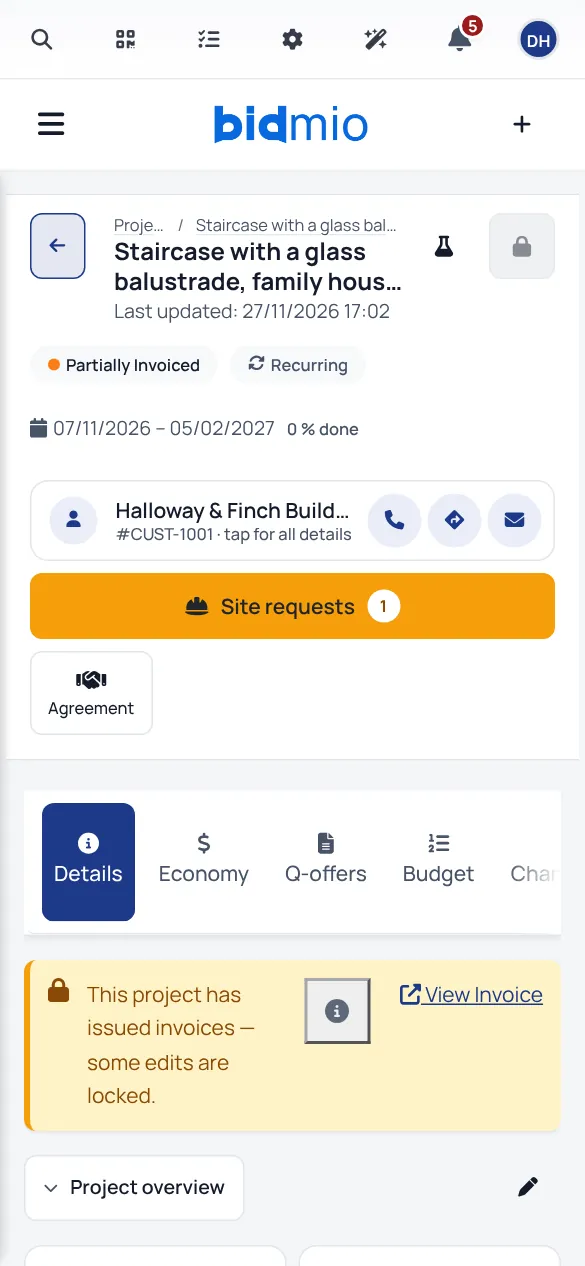
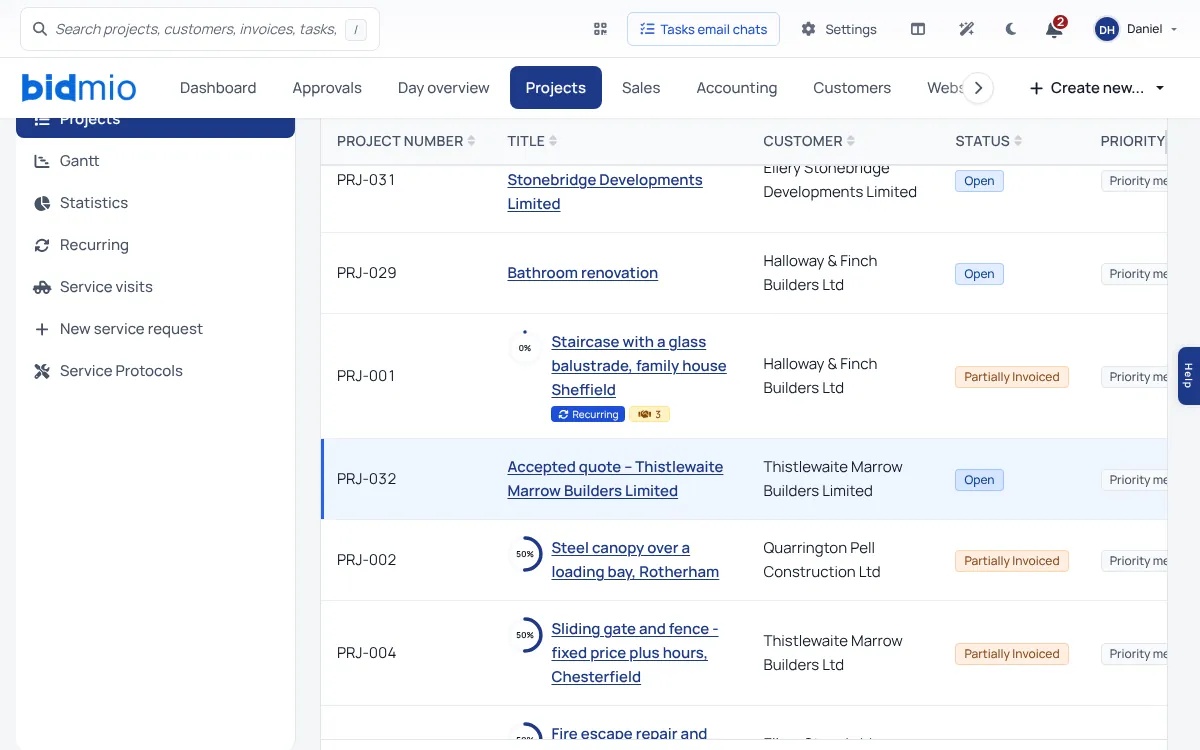
A real Bidmio screen with a steel fabricator's demo data.
One job
How metal fabrication software works: 10 steps from enquiry to payment
Daniel runs a fabrication shop in Sheffield. He has a workshop supervisor, two welders, a fabricator, a detailer who draws the 3D models, and a fitting crew. The Ashworths have finished building their house and want a steel staircase with oak treads and a glass balustrade along the landing. This is how Daniel takes the job through Bidmio.
1
Monday 8:00 · Enquiry
The customer rings and everything about them is in one place
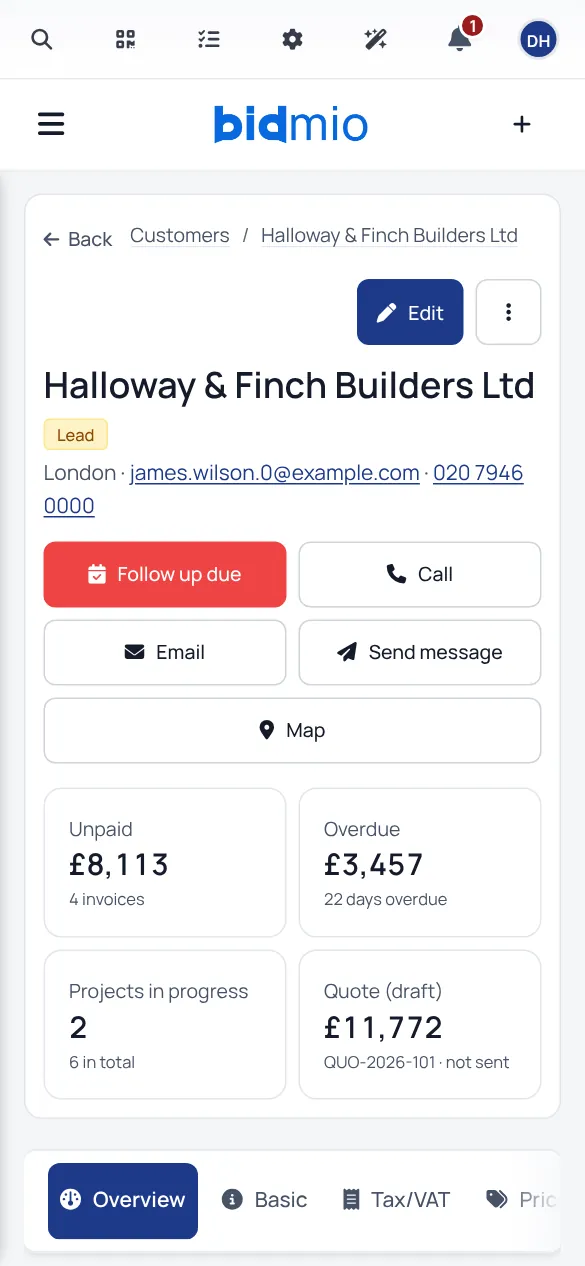
Mrs Ashworth rings because their architect recommended Daniel's firm. Daniel adds her as a customer with phone, e-mail and the house address, and creates the job Staircase with a glass balustrade right under her. When they ring next year about a gate, the quotes, invoices and payments are on the same card.
Homeowners, architects and builders on the same kind of card
Phone, e-mail and site address typed once
Every job, quote and invoice under one name
SoloProfessional
A real Bidmio screen with demo data.
2
Tuesday 9:30 · Survey
The site survey and the drawings stay with the job
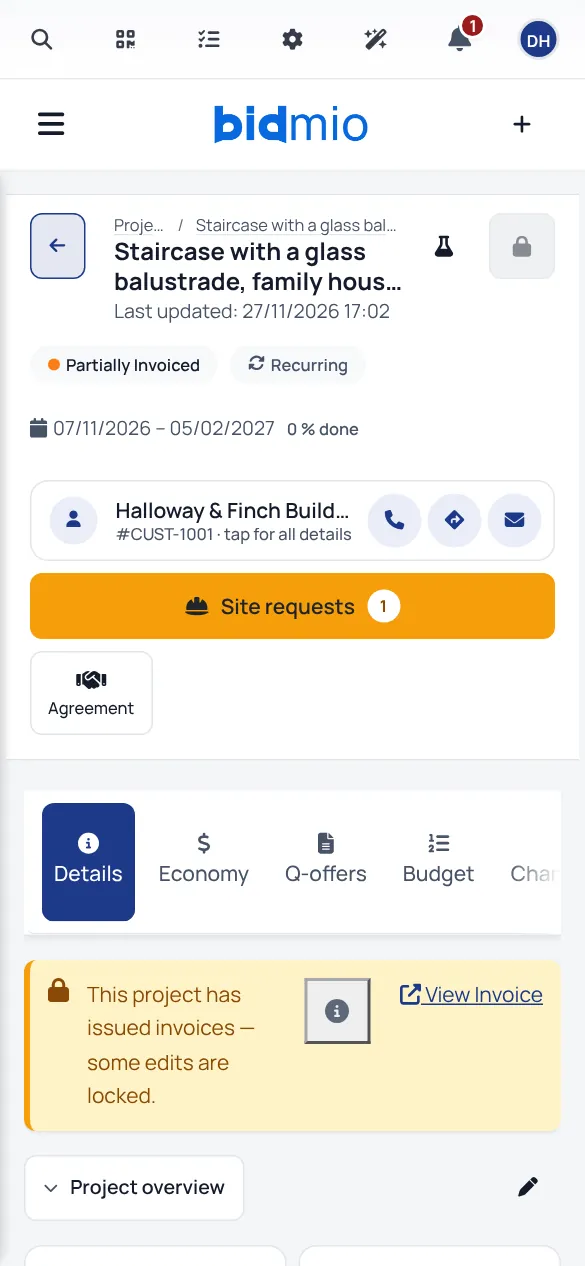
Daniel measures the stairwell, the height between floors and the length of the landing, and photographs the fixing points in the ceiling. The photos and the architect's floor plan go on the job as files. The detailer draws the 3D model and the shop drawings in Tekla or another CAD program and attaches the finished PDFs to the same job, so the workshop and the fitters work from the latest version.
Site photos and measurements on the job
Drawings and calculations as PDF files, always the latest
Tasks with dates: survey, model, drawing approval
SoloProfessional
A real Bidmio screen with demo data.
3
Wednesday evening · Quote
A staircase quote by the kilo, the metre and the hour
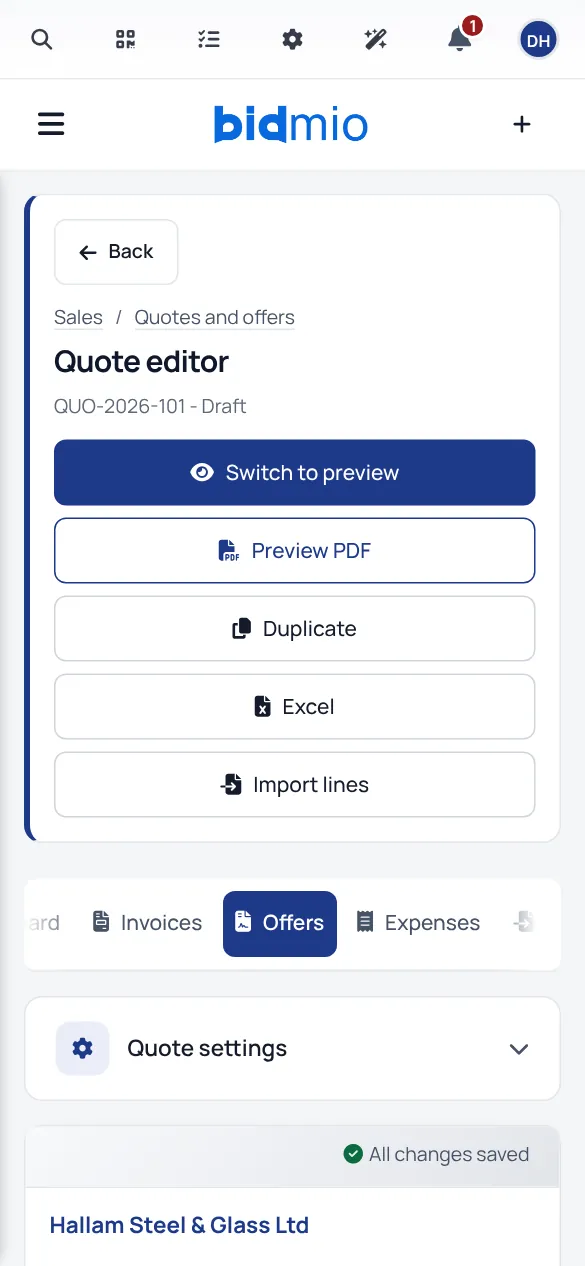
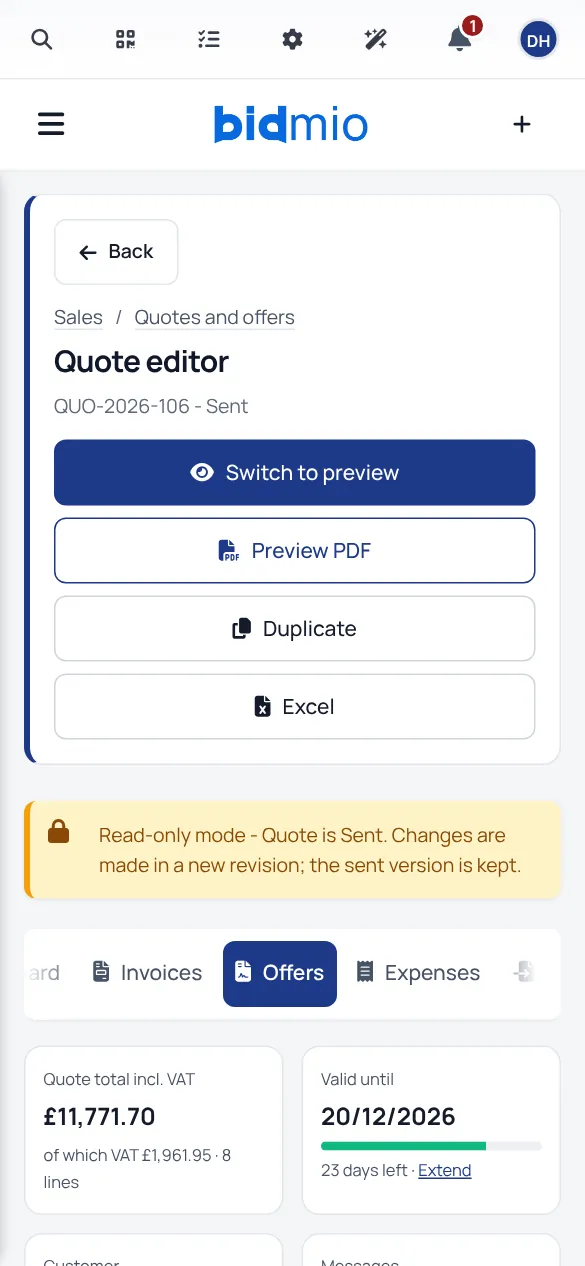
Daniel builds the quote from his own price list: site survey and 3D model £578, structural calculation and shop drawings £382.50, the steel staircase 640 kg at £3.91, galvanising and powder coating 640 kg at £1.15, 15 oak treads at £140.25, glass balustrade 7.5 m at £272, stainless handrail 7.5 m at £57.80 and fitting 32 hours at £32.30. The quote comes to £9,809.75 before VAT. He adds a wall handrail as an optional line.
Kilos, metres, m², pieces and hours in one quote
Optional lines the customer picks for themselves
The quote as a PDF with your company details
SoloProfessional
A real Bidmio screen with demo data.
4
Friday · Acceptance
The customer answers the quote through a link
Mrs Ashworth opens the link from the e-mail on her phone and goes through the staircase, the glass and the fitting. She can accept, decline, ask for a change or write a question. When the family decides, before accepting, on anthracite RAL 7016 instead of black, Daniel edits the quote and sends it again. An accepted quote no longer changes and stays on the job with its date.
Accept, decline or ask for a change
The customer never sees your buying prices
The job carries on from the accepted quote
SoloProfessional
A real Bidmio screen with demo data.
5
The following Monday · Deposit
A deposit invoice before you order glass and steel
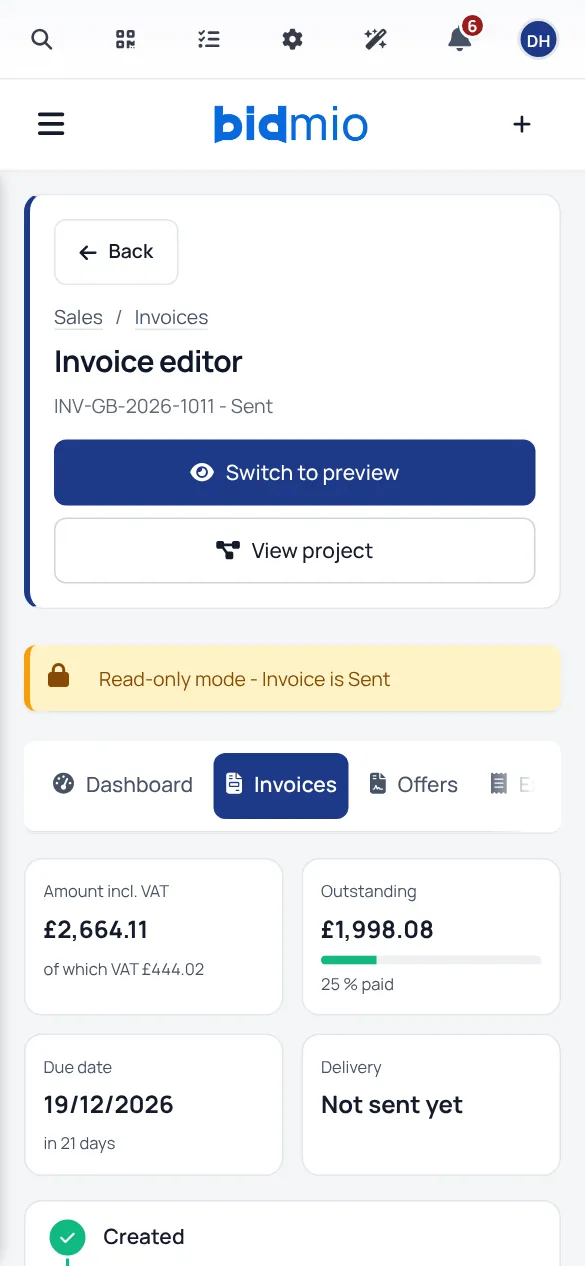
Toughened laminated glass is made to size and the supplier will not take it back. So Daniel raises a deposit invoice for 50 % of the price from the job and orders the glass and the sections once the deposit is in the bank. The PDF shows his bank details, so the customer pays by bank transfer.
Deposit, stage and final invoices
Match the payment to the invoice after a bank statement import
Nothing goes to the customer until you send it
SoloProfessional
A real Bidmio screen with demo data.
6
Week two · Workshop
Welders' workshop hours on the right job
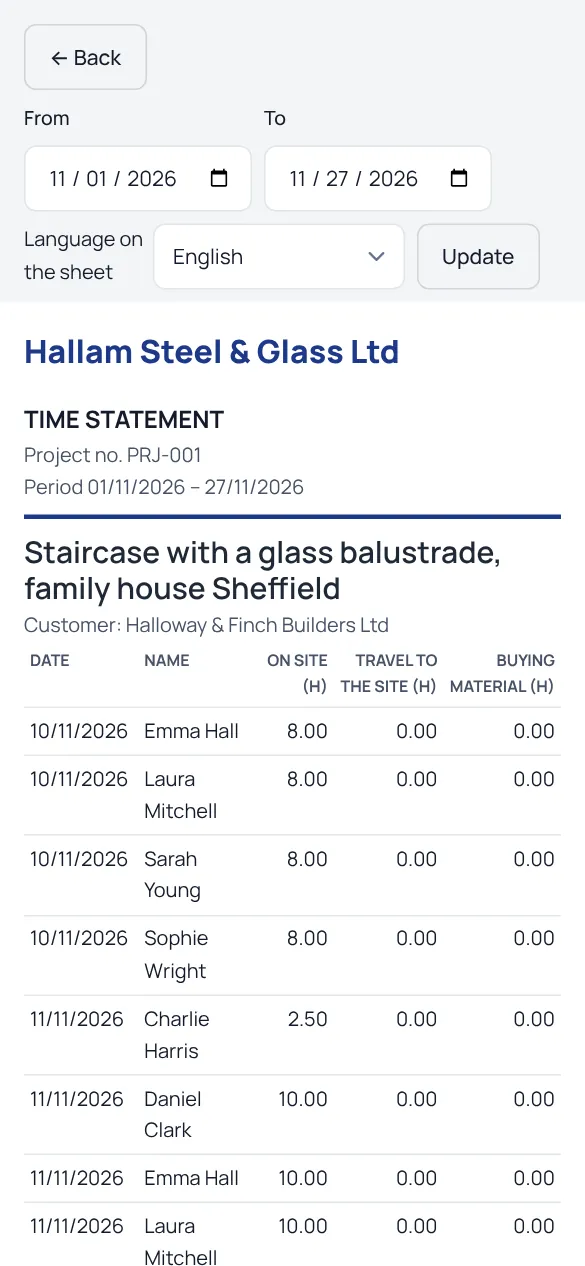
A welder taps Add work on his phone and books six hours to the Sheffield staircase with the note Welding the stringers. People clock in at the workshop door with a QR kiosk (the workshop set up as a job of its own) or their own QR badge. On the job Daniel sees how many hours the workshop has already spent on the staircase against the hours planned for the job, while the steel is still on the benches.
Hours on the job with the type of work: cutting, welding, grinding
Workshop attendance with a QR kiosk or a QR badge
Actual hours against the job's plan during fabrication
SoloProfessional
A real Bidmio screen with demo data.
7
During fabrication · Materials
Box section, plate, glass and anchors on the right job
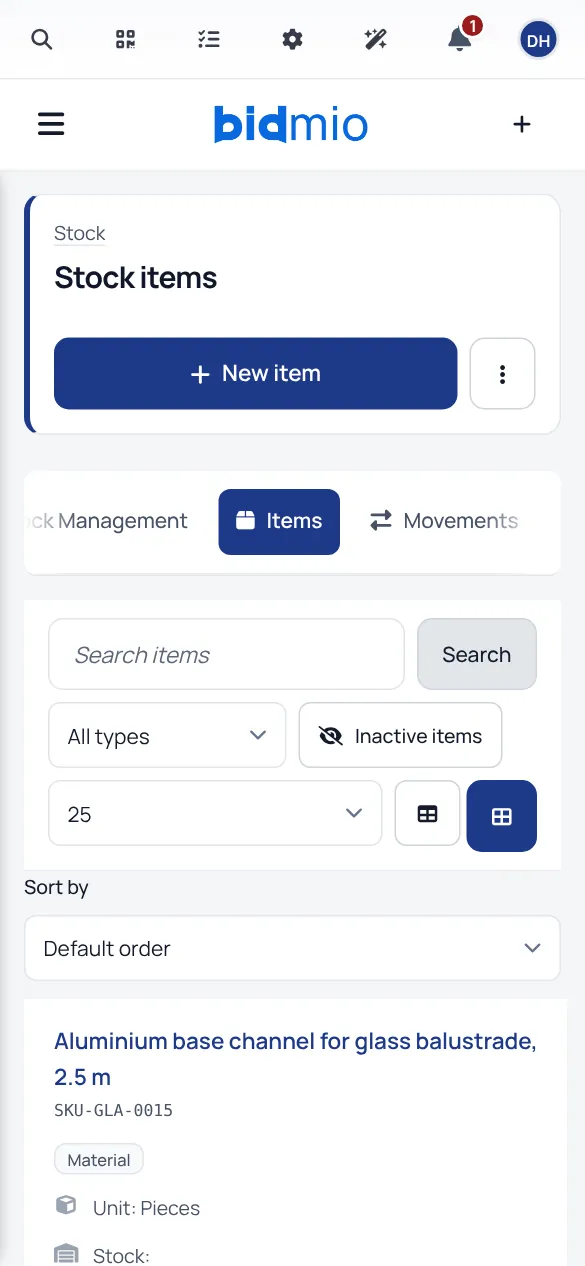
80 × 40 box section, flat bar, plate and chemical anchors are issued from stock to the job. Daniel sees what has already gone from stock to the staircase and what needs ordering, and the buying price lands in the job's costs. When welding wire or cutting discs drop below the minimum, they show up on the reorder list.
Issue from stock to a specific job
Minimum stock of wire, gas and discs
Buying price in the job's costs
Professional
A real Bidmio screen with demo data.
8
Week three · Fitting
The fitting crew knows where and when they are fitting
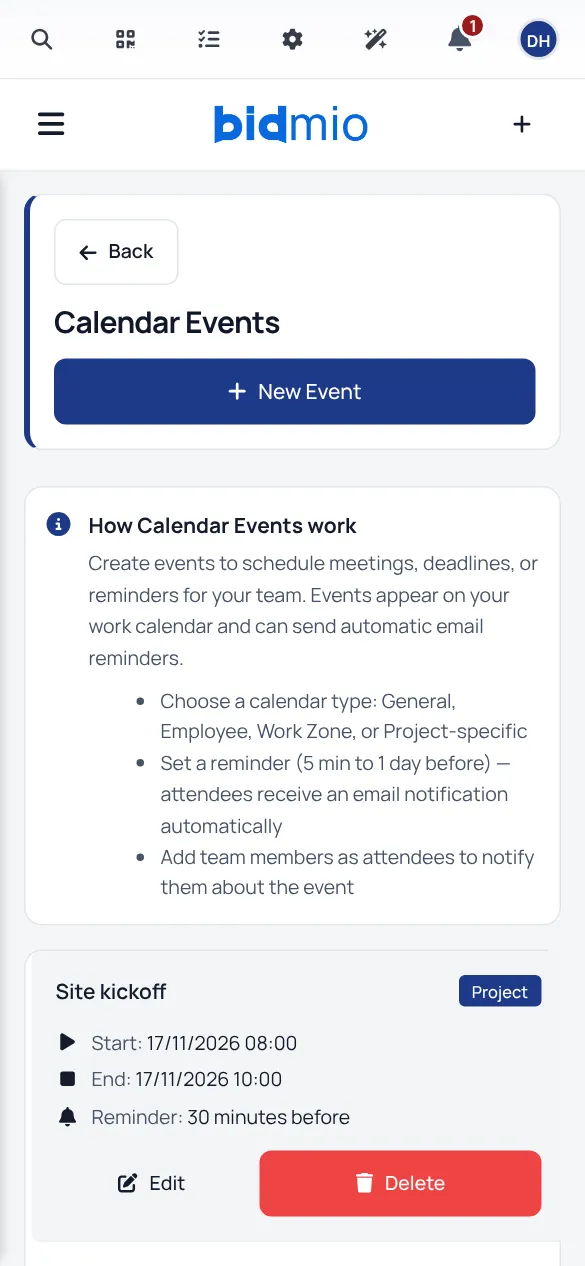
In the calendar Daniel books two fitters on Thursday and Friday for the Sheffield site. The fitters see it on their phones straight away, with the address and directions. On site they note the anchors, the staircase and the glass in the site diary and add photos that cannot be taken once everything is covered.
People and jobs planned by the day and the week
Installations anywhere without ringing round the crew
Site diary with photos from the fitting
Professional
A real Bidmio screen with demo data.
9
After handover · Invoice
The final invoice from the job, with your bank details
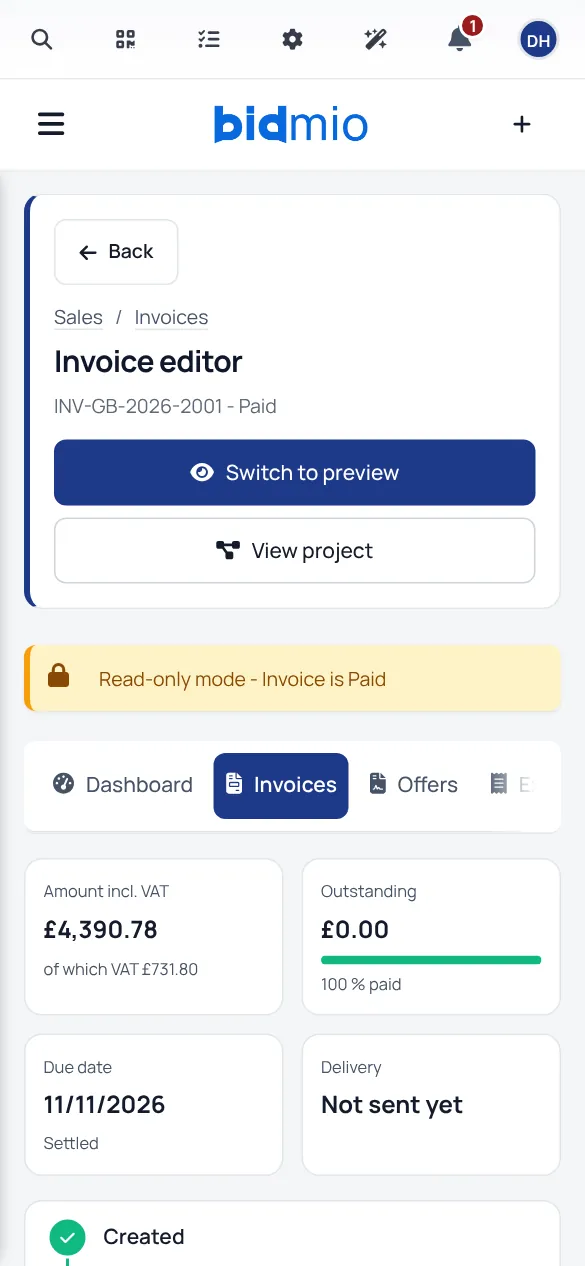
Once the staircase is fitted and handed over, Bidmio builds the final invoice from the quote lines, the extra work the customer approved through the link and the hours worked, and the paid deposit comes off. Daniel checks it and sends it. The invoice goes out as a PDF with his bank details, and after a bank statement import you match the payment to the invoice.
Quote lines, approved extra work and hours worked
The paid deposit comes off the final invoice
Payment matching after a bank statement import
SoloProfessional
A real Bidmio screen with demo data.
10
A year later · Service
Gate servicing and warranty claims with the full history
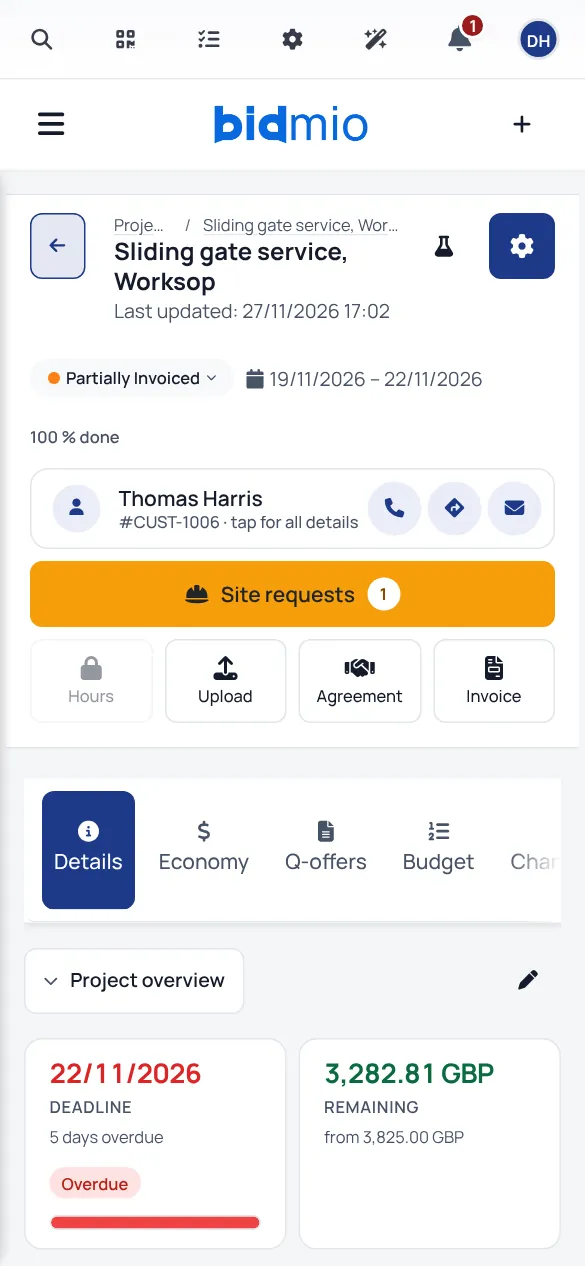
Another customer reports that a sliding gate stops halfway. The visit is on the list with the address, the phone number and a checklist: rollers, motor, limit switches and photocells. The fitter records the measured stopping force, photographs the gate before and after the repair, and the visit goes straight onto an invoice. The original job with its drawings and photos is one tap away.
Visits with directions and a checklist
Measurements and photos before and after the repair
Annual gate and balustrade inspections under contract
Professional
A real Bidmio screen with demo data.
Why it matters
The staircase is fitted. The profit went in the workshop.
A fabrication firm loses money where nothing is written down: a welder spends twenty hours more on the stringers than the quote allowed, the glass is ordered before the deposit and the customer changes a size, or a fitter spends two days on a reveal nobody knew about.
Today
A spreadsheet quote with a price per kilo nobody checks after fabrication
Workshop hours on a sheet by the saw, site hours in the foreman's head
Glass and stainless ordered before the customer has paid
Sections and anchors taken to site with no record
The invoice pieced together from e-mails and phone photos
With Bidmio
An itemised quote from your own price list in kg, metres and hours
Welders' and fitters' hours booked to the job from the phone
A deposit invoice before you order the glass
Material issued from stock to a specific job
The final invoice from the quote and the hours, less the deposit
Live demo
Look around Bidmio with a steel fabricator's data
A demo fabrication firm with a staircase and glass balustrade, a loading bay canopy, balcony balustrades, a sliding gate, stock of sections and glass, and service visits. No sign-up needed, and the data resets every night.
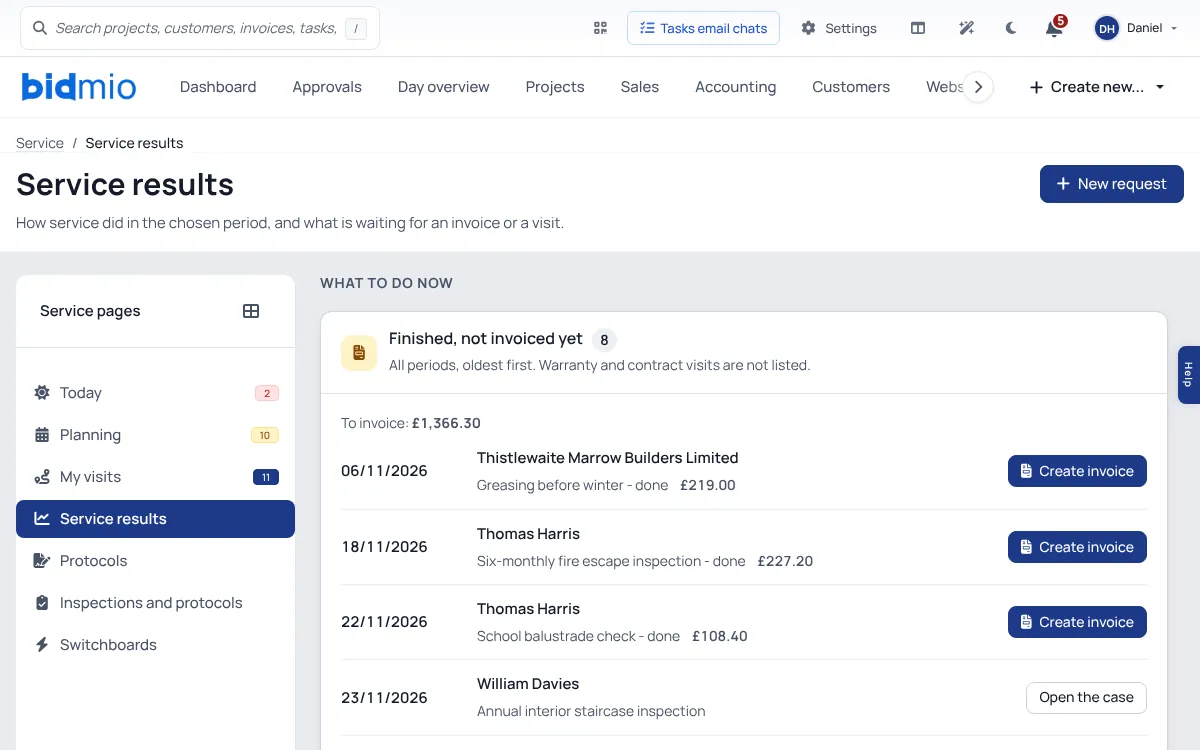
New gate rollers, tightened wires on a hotel terrace, a new glass panel in a balcony balustrade. Small visits get lost between big jobs. Here all the finished ones that are not yet invoiced are in one place.
app.bidmio.com
After the job
Fabrication after the fitting: the final payment and a review
The balustrade is fitted and the glass is in. Bidmio watches the final payment, the quotes from the workshop and the review after the fitting for you.
Payment reminders go out on their own
The balance for a staircase with a glass balustrade only comes after the fitting, and it is usually the largest. Before the due date the customer gets a polite reminder. If they do not pay, Bidmio e-mails a reminder, then a firmer one and finally a last notice. You set how many and how often. The payment from the bank is matched with the invoice, so nobody chases a paid invoice. In a dispute you stop the reminders for that one invoice.
You see whether the customer opened the quote
A quote for a gate or a balustrade counts kilos and metres, and you want to know whether the customer has opened it. On the quote you see when the customer opened it, and they can accept it on their phone. Before it expires Bidmio tells you, so you call before the customer calls someone else.
A review on Google or Trustpilot
Every visitor sees a stainless balustrade, and a review from its owner brings the next job. Once the customer has paid, Bidmio waits a few days (you choose how many) and sends a thank-you with a link to your Google page, or an invitation from your Trustpilot account. One customer gets at most one request in three months and can opt out with one click.
In detail
A fabrication firm in practice: what to price, what to record and what to watch
Bespoke fabrication has its own rules, with software or without it. Here is what fabrication firms deal with every week, and where Bidmio helps.
How to price fabrication work: kilos, metres and hours
Steelwork is most often priced by the kilo. The price per kilo carries the material, cutting, welding, grinding and the workshop's overheads. It works well for beams and simple frames, but a staircase with lots of detail or a balustrade with bent parts is easily underpriced. A welder's hour per kilo on thin box section is something quite different from one on an HEA beam.
Balustrades are priced by the metre, glass by the square metre, treads, anchors and motors by the piece and fitting by the hour. Most money is lost where units mix without a check: the quote counts the staircase in kilos, but on site there is suddenly a reveal, an extra landing or fixing into insulated masonry that nobody counted in kilos.
In Bidmio you set up the items once in your own price list with a unit, a selling price and VAT: fabrication per kilo, glass per square metre, balustrade per metre, fitting per hour and the 3D model as a lump sum. For the next quote you only pick them and add the quantity. The customer sees optional lines, such as a wall handrail or an electric gate motor, separately and decides whether they want them.
Steel in kg, balustrade in metres, glass in m²
3D model, calculations and shop drawings as separate lines
An hourly fitting rate for what cannot be measured in advance
Survey, 3D model and shop drawings
A bespoke staircase or balustrade cannot be made without an accurate survey. A few millimetres in floor height or in a wall that is not plumb mean the glass will not sit or the stringer will not meet the ceiling. So it pays to have the survey, the model and the drawing approval as separate steps of the job with dates, and to price them separately too.
Bidmio does not draw and does not replace Tekla, AutoCAD or any other CAD program. It is where their output meets the job: survey photos, shop drawings as PDFs, the structural calculation and the customer's approval are kept on the job. The workshop and the fitters open the same latest version, not a drawing someone e-mailed a month ago.
When the customer changes a size or a colour after accepting the quote, the accepted quote is not rewritten. You make a copy of it or a quote for the extra work and send it for approval. The original quote and the change stay traceable with their dates, so there is no argument at invoicing about what was agreed.
Deposits before you order glass and material
Toughened and laminated glass is made to size. If the customer changes their mind after you order, you cannot sell the glass to anyone else. The same goes for stainless, galvanising and powder coating, which you pay subcontractors for before you are paid yourself.
That is why fabrication firms work with deposits: part of the price on signing, typically before glass and material are ordered, and the balance after fitting. In Bidmio you raise the deposit invoice straight from the job, with your bank details on the PDF. When you import the bank statement, you match the payment to the invoice and know you can order. On the final invoice Bidmio offers to deduct the paid deposit.
Workshop hours: where the profit goes
The great unknown in fabrication is time in the workshop. The quote allows thirty hours for a staircase, but welding, grinding and straightening after welding take fifty. When nobody records it, the firm finds the loss at the year end, and even then does not know which job it was.
In Bidmio a welder or fabricator books hours to the job from the phone, with the type of work. On the job you then see the actual hours against the hours planned for the job, during fabrication rather than after the fitting. After a few jobs you know how many hours per kilo a staircase really takes and how many a canopy, and you price more accurately.
People clock in when they arrive at the workshop with a QR kiosk (the workshop set up as a job of its own) or their own QR badge. The hours go into the payroll records, so nobody types them twice.
Hours on the job with the type of work
Actual against the job's plan during fabrication
Workshop attendance with a QR kiosk or a QR badge
Steel sections, stainless and glass in stock
Box section, flat bar, plate, stainless tube, anchors, welding wire, gas and discs are, after people, the biggest cost of a fabrication job. Some material is bought for a specific job and some is kept in stock, and that is the part that melts away: offcuts go into another job and nobody records it.
On the Pro plan you keep stock: receipts into stock, issues to a specific job and minimum levels for consumables. AI reads the delivery note and matches it to the purchase order. The buying price lands in the job's costs, so during fabrication you can already see whether the job is making money. When wire or shielding gas drops below the minimum, it shows up on the reorder list.
Fitting on site: crews, plan and diary
A fabrication firm that fits with its own people deals with the same thing every week: which crew goes where, which truck has the crane arm and when a mobile crane is needed. When one installation slips because the site is not ready, the others slip with it.
The people plan in the Bidmio calendar shows who is on which site on which day. When a date changes you change it in one place, and the fitters see it on their phones with the address and directions. On site they note in the site diary what was fitted, how many people and hours, and add photos of the fixings that nobody will see once they are covered.
Changes during the job and extra work
Hardly any staircase or balustrade is fitted exactly as quoted. The customer adds a wall handrail, extends the landing balustrade or changes the colour after the steel is already at the powder coater. If it is only agreed by word of mouth, it ends in an argument.
Record every change with its amount and have it approved before you do it. On the Business plan each piece of extra work has its own change order with a status; on smaller jobs a quote for the extra work, approved by the customer through a link, is enough. Approved changes go onto the invoice, so they are not forgotten.
Gate servicing and regular inspections
Sliding gates, barriers and fire escapes need regular checks. For a fabrication firm that is steady income between big jobs, as long as nobody forgets the inspections and every visit becomes an invoice.
In Bidmio you set up the equipment at the customer, for example a motorised sliding gate, with a checklist and measurements. On the visit the fitter ticks off the rollers, the motor and the photocells, records the measured value and photographs the state of the gate. Finished visits not yet invoiced are in one list.
What Bidmio does not do for fabricators
Bidmio is software for running jobs, people, material and money. Some things it deliberately does not do, and it is fair to say so up front.
It does not draw 3D models or shop drawings and has no direct link to Tekla: you keep its drawings on the job as PDFs
It does not calculate structures and does not replace a structural engineer
It does not plan workshop machines or the order of operations; it plans people and fitting crews
It does not optimise the cutting of sections or glass
It does not decide VAT, warranty or whether a claim is justified for you
Typical jobs
Software for everything a fabrication shop makes
From a single garden gate to the steel frame of a shed.
Interior staircases
Stringer, mono-stringer and spiral staircases with timber or steel treads. A fixed price for the staircase and extra hours for adjustments on site.
Glass and stainless balustrades
Side-fixed glass, glass in an aluminium channel, stainless with wire or rod infill. A price per metre, and the glass ordered only after the deposit.
Bespoke steelwork
Canopies, mezzanines, landings, shelters and beams. Fabrication by the kilo, galvanising as a subcontract and erection with a crane.
Gates and fences
Sliding and swing gates, pedestrian gates with electric locks and fence panels. Motor installation and an annual service under contract.
Fire escapes
External galvanised stairs with grating landings. Six-monthly checks of the fixings and the galvanising, with a report for the building manager.
Repairs and warranty claims
Cracked glass, rust on a landing, creaking treads. A visit with photos before and after the repair and measurements taken on the spot.
Switching
Spreadsheets, a sheet by the saw and an invoicing app: what a fabricator puts away
Customers, jobs and the price list usually come across; stock levels and older history do not move on their own. We do the switch together on a call.
Bidmio bills in euros, your invoices go out in poundsBidmio plans are priced and billed in euros, so your card or bank converts the monthly amount to pounds. Everything your firm sends to customers, quotes and invoices included, is in pounds with UK VAT.
Your accountant keeps the booksYour accountant gets external access to the companies you pick, and you can remove it in one click. They see the invoices, supplier receipts and bank matches, or you send a CSV export. Bidmio does not file with HMRC and does not replace Xero, QuickBooks or Sage.
Can I price a staircase by the kilo and a balustrade by the metre?+
Yes. Every price list item has its own unit: kilo, metre, square metre, piece or hour. You can combine them in one quote, for example the steelwork in kilos, the glass in metres and the fitting in hours.
Is Bidmio linked to Tekla or another CAD program?+
No. Bidmio does not draw models or drawings and has no direct link to Tekla. You keep the drawings and calculations from them on the job as PDFs, so the workshop and the fitters have the latest version.
Can I see how many hours the workshop really spent on a job?+
Yes. Welders and fabricators book hours to the job from the phone and clock in with a QR kiosk (the workshop set up as a job of its own) or a QR badge. On the job you see the actual hours against the hours planned for the job while fabrication is still going on.
Does Bidmio plan the workshop and the machines?+
No. Bidmio plans people and fitting crews in the calendar. It does not handle the order of operations on the machines or the workshop's capacity.
Can I see how much material went to which job?+
Yes, on the Pro plan. You receive material into stock and issue it to a specific job. The buying price goes into the job's costs, and you set a minimum level for consumables.
Can I raise a deposit invoice before I order the glass?+
Yes. You raise the deposit invoice straight from the job, with your bank details on it. On the final invoice Bidmio offers to deduct the paid deposit.
Can I look at Bidmio before I sign up?+
Yes. You open the fabrication firm's demo account without signing up. When you want to try it on your own jobs, the first month costs a tenth of the price.